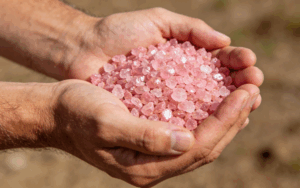
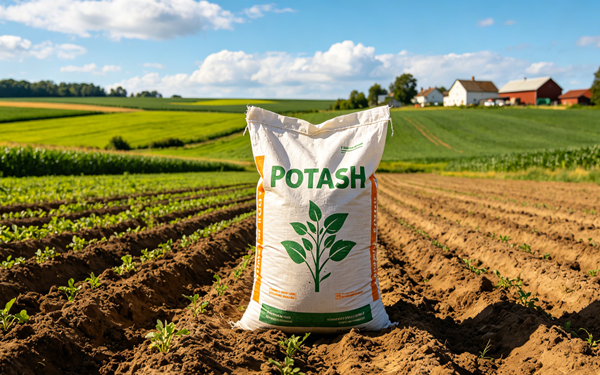
President Donald Trump says he is working on a “massive deal” to buy potash from Belarus at prices “substantially less” than what the United States now pays Canada — an unexpected overture that has put the world’s largest potash producer, Nutrien (NTR), squarely under the market microscope. The question hanging over the sector is whether the gambit is mere geopolitical leverage, or a genuine threat to the Canadian champion that dominates North American supply.
The numbers behind the relationship leave little room for complacency. The U.S. imports nearly 85% of its potash from Canada, with Saskatchewan alone accounting for more than 86% of Canadian potash shipped south. Canada, the world’s top exporter, moved roughly 22.9 million tonnes in 2024. Potash is both a critical input for North American farmers and an increasingly contested critical-mineral chip in the U.S.–Canada trade war — so Trump’s pivot toward Minsk drew an immediate and pointed rebuke.
Saskatchewan Premier Scott Moe called the tentative deal “wrong and it doesn’t make sense.” With more than 40 countries already sanctioning Belarus for its role in Russia’s invasion of Ukraine, Moe branded the proposed purchases “blood potash,” arguing that buying from Belarus effectively funds Russian aggression. “Does anyone believe Belarusian blood potash shipped through Russia is going to be more affordable, more sustainable or more ethical than potash shipped from Saskatchewan?” he posted on X.
Yet the logistics may work against the deal as much as the politics do. Belarusian media quote President Alexander Lukashenko as saying that even if Minsk wanted to reach Western markets, “there is nothing left to supply.” Since February 2022, the landlocked country has been barred from exporting through the Lithuanian port of Klaipeda. Belarus ranks third globally in potash output, behind Russia and Canada, but its outbound corridors remain pinched. Washington itself has already edged toward Minsk: in December 2025, the U.S. agreed to lift sanctions on Belarusian potash after Nobel Peace Prize laureate Ales Bialiatski and other opposition figures were released with the help of a Trump envoy.
The episode also opens a new flank in the U.S.–Canada trade standoff. In June, Trump told reporters there is “nothing” the U.S. needs from Canada. But U.S. Ambassador Pete Hoekstra conceded that when it comes to Canadian potash, there are “not lots of other places that you can get it.” Canadian premiers are split on whether to weaponize the resource: Ontario’s Doug Ford has pushed retaliating against U.S. tariffs by restricting electricity, oil and mineral flows, while Moe and Smith have ruled out export taxes or supply withholding, warning that losing America as a customer would cost jobs and hike prices at home. For now, Canadian potash remains exempt from Trump’s tariffs.
For Nutrien investors, the central question is whether the Belarus noise changes the underlying thesis. The company operates large-scale, low-cost Saskatchewan mines in a politically stable jurisdiction and is forecasting 74 million to 77 million tonnes of global potash shipments in 2026, with management saying demand is already testing existing production and logistics capacity. The earnings are reflecting that tightness: second-quarter adjusted EBITDA reached $2.4 billion, adjusted earnings came in at $2.61 per share, first-half potash sales hit a record, and management raised its full-year sales-volume outlook. Valuation is comparatively calm — roughly 15 times forward earnings with an annualized dividend yield near 2.8% — a far cry from the multiples attached to the AI, nuclear and defense names riding the same strategic-supply-chain wave. The risks are the familiar ones: fertilizer prices are cyclical, agricultural demand tracks crop prices, and rivals could ramp output.
Prime Minister Mark Carney is betting that Canada’s resources remain the prize. Ottawa has signed more than 50 critical-minerals agreements with over 15 countries over the past year, unlocking $20 billion in investment, with the stated goal of “reducing dependence on foreign chokeholds in critical supply chains.”
The bottom line: Trump’s Belarus gambit looks more like a bargaining card than a near-term supply shock. With Belarus’s export corridors blocked, sanctions politics unresolved, and Canada’s politically stable, low-cost production effectively irreplaceable for U.S. farmers, the announcement may rattle sentiment but leaves Nutrien’s core case intact. Food demand does not vanish because commodity markets have a bad quarter — and sometimes the most strategically important mineral is not powering an electric vehicle or sitting inside a missile. Sometimes it is helping grow dinner.